

Cost and sustainability
Single use versus reusable: the real cost per serve
The lowest quoted unit price does not tell you which cup system costs less. A fair comparison adds every cost required to serve the drink, recover or discard the cup, meet hygiene requirements and handle the resulting waste.



Key points
- Compare the cost of one completed drink service, not one single-use cup with one reusable cup.
- Count waste, handling and clearance costs on the single-use side.
- Count returns, washing, storage, labour and losses on the reusable side.
- Use observed rotations and return performance rather than a theoretical product lifespan.
- Keep financial and environmental break-even calculations separate.
Start with one completed serve
Set the comparison before opening a spreadsheet. Both systems must provide the same function: the same number of drinks, in the same cup capacity, across the same venue and period.
Cost per serve = total system cost for the period / completed drinks served
Use the same till or dispense count for both options. Decide in advance whether lids, delivery, VAT and contractor charges are included, then apply that decision to both sides.
Manchester City Council's event guidance makes the same practical point in a different way: the business case varies with event scale, service arrangements and the way cups are managed. It identifies avoided disposable purchases, waste costs, reusable cup purchase or service costs, deposits and management costs as separate parts of the calculation. [1]
For the cup input, use a current written quote rather than a remembered price. You can compare Cup Heroes cup and print options, then place the relevant delivered figure into your model. Keep the supplier quote, expected service volume and assumptions together so the result can be checked later.
Count the costs behind single use
The single-use column starts with the landed cup cost:
cups purchased
+ freight
+ any lids or accessories used only with that system
It does not end there.
Add the cost of distributing stock to bars, topping up service points, providing bins and liners, moving waste, litter picking, post-event clearance and commercial waste collection. Use payroll records and contractor invoices rather than estimates wherever possible.
Businesses have responsibilities for minimising, storing and transferring commercial waste, including checking that the carrier is authorised and completing the required waste documentation. The relevant national guidance differs across England, Wales, Scotland and Northern Ireland. [2]
For venues in England, workplace recycling rules have required most workplaces to separate dry recyclables, food waste and residual waste since 31 March 2025. The rules also cover waste produced by customers and visitors. Micro-firms with fewer than ten full-time equivalent employees have until 31 March 2027. [3]
That guidance also warns that contaminated recycling may be refused or attract additional contractual charges. Packaging marked compostable or biodegradable cannot simply be placed in the food-waste stream. It must normally be treated as residual waste or collected through a suitable dedicated service. [3]
Your single-use worksheet should include:
- landed cup and accessory cost
- unused or damaged stock
- staff handling time
- customer-facing and back-of-house bins
- liners and waste-storage equipment
- recycling and residual-waste collections
- contamination or excess-weight charges shown in the contract
- litter-picking and post-event clearance
- waste administration and contractor management
Do not assign an arbitrary saving to recycling. Enter the amount your waste contractor actually charges for the material, container size and collection frequency at your site.
Count every reusable-system cost
A reusable cup is part of a service system, not a one-off purchase.
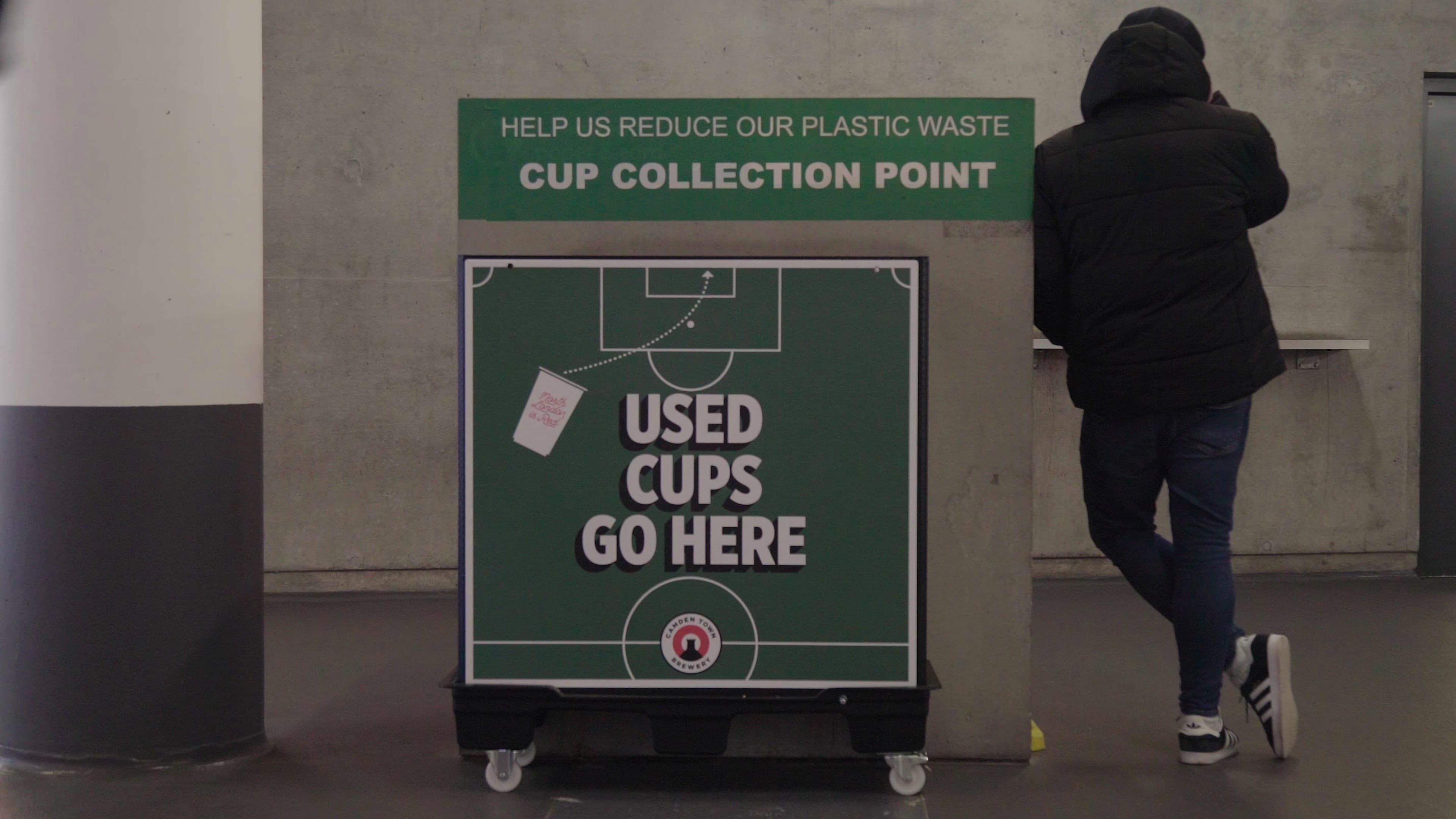
Begin with the landed fleet cost, then add replacements for cups that are lost, damaged or rejected after inspection. Include return points, collection containers, staff handling, washing, drying, storage and any transport to an off-site wash facility.
Reusable cups used for drinks must sit inside the venue's food-hygiene procedures. UK government guidance requires food businesses to be able to demonstrate effective cleaning and to maintain a schedule covering what is cleaned, how often and which products are used. [4]
The reusable worksheet should include:
- initial cup fleet
- replacement cups
- return-point equipment and signage
- payment or deposit-system charges
- cup collection and internal transport
- sorting and inspection labour
- washing labour or a contracted wash price
- water, energy and detergent where washing is in-house
- drying, racking and secure storage
- transport to and from an external wash facility
- damaged-cup and end-of-life handling
- stock counting and reconciliation
Return performance must be measured locally. A UCL East trial reported that 79 per cent of its reusable cups were returned and disposable cups fell to 15 per cent of purchases. That is useful evidence that a return system can operate in a busy setting, but it is not a forecast for a festival, stadium or pub. The audience, return points, deposit, opening hours and service pattern were specific to that trial. [7]
Use the specification lifespan only as a ceiling. For the cost model, use actual completed rotations:
Observed uses per cup cohort =
total drinks served from that cohort
/
cups originally introduced into the cohort
Track one identifiable batch until it is lost, retired or still held in usable stock. Counting a cup as returned once does not show how many services it ultimately completes.
Research into reusable systems supports this system-wide approach. A cup lifecycle study found that washing method, transport and end-of-life treatment can materially change the result. [5] A 2024 UK study of returnable takeaway containers likewise found that return behaviour, durability, washing energy and system design interact, so success cannot be inferred from the container alone. [6]
Build a calculation you can audit
Use the same number of forecast serves, the same trading period and the same tax basis on both sides.
Single-use cost per serve =
(
  cup purchases
  + freight
  + handling labour
  + bins and liners
  + waste collections
  + litter and clearance
  + administration
)
/
completed serves
Reusable cost per serve =
(
  allocated fleet cost
  + replacement cups
  + return infrastructure
  + washing
  + handling labour
  + transport
  + storage
  + residual waste
  + administration
)
/
completed serves
For a reusable fleet that continues into another season, do not charge its entire purchase cost to one event and then silently treat later use as free. Allocate the cost using measured lifetime use:
Allocated cup cost per serve =
(
  landed cost of the cup cohort
  - supportable residual value
)
/
lifetime serves completed by that cohort
If lifetime use is not known, calculate low, base and high scenarios for service volume, return rate, average rotations, washing cost, staff hours, replacement quantity and waste or clearance savings. Use a supplier figure or measured value for every entry, and label any remaining assumption.
Refundable customer deposits should be tracked separately from operating cost. A deposit returned to the customer is a cash movement, not a guaranteed saving. If your terms allow a charge to be retained when a cup is not returned, show that amount as a separate sensitivity based on an observed loss rate. Do not build the business case on an assumed pot of retained deposits.
A simplified break-even calculation is:
Break-even serves =
extra reusable fixed cost
/
(
  single-use variable cost per serve
  - reusable variable cost per serve
)
This shortcut is valid only when the denominator is positive and every material cost has already been included. The full model remains the better decision tool.
Before placing an order, align the model with how the ordering process works and the current lead-time information. That prevents the financial comparison from ignoring rush freight, temporary storage or a service change caused by ordering late.
Run a representative pilot
A representative pilot is more useful than a generic online break-even number.
Record:
- cups introduced into service
- drinks served
- cups returned
- cups successfully washed and reissued
- cups rejected because of damage or contamination
- staff hours by task
- wash cycles and contractor charges
- cups remaining in usable stock
- cups lost
- waste volume and invoiced collection cost
Reconcile those figures after the event, then replace spreadsheet assumptions with observed data.
Keep environmental reporting separate. A reusable system can reach a financial break-even point before or after it reaches an environmental one. Lifecycle research on cups shows that results change with the cup material, washing arrangement, transport, end-of-life route and environmental impact being measured. [5] The UK return-system research also shows why high return, continued acceptance and efficient washing matter to environmental performance. [6]
The defensible conclusion is specific:
Under the volumes, return rate, labour, washing and waste charges measured at this venue, one system cost GBP X per completed serve and the other cost GBP Y.
That is stronger than claiming that either format is always cheaper or always greener.
If you are planning a bar or event, review the reusable festival cup range, gather your own operational inputs, then contact Cup Heroes for the cup-side figures needed to complete the model.
Sources
- Reusable Cups at Events: Why It Matters and How to Do ItManchester City CouncilAccessed 17 September 2026
- Dispose of business or commercial waste: Your responsibilitiesUK GovernmentAccessed 17 September 2026
- Simpler recycling: workplace recycling in EnglandDepartment for Environment, Food and Rural AffairsAccessed 17 September 2026
- Food hygiene for businesses: CleaningUK Government and Food Standards AgencyAccessed 17 September 2026
- Assessment of the environmental break-even point for deposit return systems through an LCA analysis of single-use and reusable cupsSustainable Production and ConsumptionAccessed 17 September 2026
- Integrating behavioural, material and environmental science to inform the design and evaluation of a reuse system for takeaway foodResources, Conservation and RecyclingAccessed 17 September 2026
- Return-to-Earn reusable cup scheme trialled at UCL EastUniversity College LondonAccessed 17 September 2026