

Festival planning
Reusable cups at festivals: what to order and when
Order reusable festival cups by working backwards from the bar operation, not from ticket sales alone. Confirm the drinks menu, peak serves, washing turnaround, return model, storage and artwork before setting a quantity.


Key points
- Forecast serves by cup size for the busiest period between clean-stock replenishments.
- Decide who supplies, collects, washes, counts and stores the cups before requesting a final quantity.
- Match cup capacities and the bar's measuring method to the drinks menu before approving artwork.
- Treat return points, signage and staff briefing as part of the cup system.
- Confirm current supplier capacity and the required delivery date in writing.
Start with the cup system, not a cups-per-person guess
Attendance is only one input. Two festivals with the same number of visitors can need very different cup stocks if one trades for a single afternoon and the other runs several bars over a weekend.
Manchester City Council's reusable-cup guide tells organisers to decide whether cups will be bought or rented, how the bar company and concessions will participate, how the system will operate, and how it will be communicated. Suppliers may provide branded or generic stock, with washing onsite, offsite each day, or after the event.1
Settle these questions first:
- Which drinks will be served, and which cup size will each use?
- How many bars and service points will use each size?
- Will customers keep one cup, exchange a dirty cup for a clean one, or return cups separately?
- Will the scheme be free to the customer, refundable, or based on a non-refundable charge?
- Can cups leave the controlled event area?
- Who owns the stock count at delivery, during trading and after close?
- Where will clean and used cups be held at each bar?
- When and where will washing happen?
- Exactly when will the next clean batch reach the bars?
The guide identifies free-to-user, refundable-deposit and non-refundable models as common UK approaches. It also makes clear that the success of a return system depends on communication, convenient return points and the event's audience, not simply on charging customers.1
Once the operating model is clear, use the festival cups range to identify suitable products, then compare cup and print options. Product selection should follow the service plan, not replace it.
Calculate stock from the longest unwashed service window
A practical quantity calculation starts with the period during which each cup can be used only once because no washed stock will return. This is a planning method, not an industry-standard formula.
For every cup size:
- Divide the event into confirmed clean-stock replenishment intervals.
- Forecast the number of serves during each interval.
- Use the busiest interval as the base working-stock requirement.
- Add a reserve agreed with the supplier for non-returns, breakages and a delayed washing or transport cycle.
- Check that storage, washing capacity and transport can support the schedule on which the calculation depends.
If all washing happens after the event, the Manchester guide says the supplier needs to provide enough cups for the total number of drinks expected across the event. If clean stock returns daily, calculate each day separately and verify that the washed batch will be back before the next service begins.1
Continuous onsite washing can shorten the interval, but only if the washer's throughput, collection route and first return time have been confirmed. Do not count a used cup as available merely because it has been placed in a return bin.
Build the forecast from operational evidence where possible:
- hourly sales from previous editions
- expected serves by drink type
- the timetable and likely peak periods
- bar count and service capacity
- opening and closing times
- planned complimentary or backstage service
- the proportion of drinks using each cup size
Avoid converting total attendance directly into cups. Attendance does not tell you how many drinks will be bought, when they will be bought, which sizes they require, or how quickly cups will return.
Send the assumptions with the enquiry. A supplier can challenge an unrealistic wash cycle or quantity more effectively when the calculation is visible.
Choose sizes and artwork before approving print
The cup specification must match the drinks menu and the bar's legal measuring method.
UK Government guidance states that draught beer and cider sold by the glass must be sold in a third, half or two-thirds of a pint, or in multiples of half a pint.2 Current Office for Product Safety and Standards guidance says that when a capacity serving measure is used to measure and serve alcohol, it must meet the applicable requirements and carry the required conformity markings. Approved measuring equipment may instead be used to deliver the specified quantity.3
Ask the licensed bar operator to confirm, for every drink:
- the quantity being sold
- whether the cup or separate bar equipment performs the measurement
- the required fill line and conformity marking
- the nominal cup capacity needed above that measure
- whether the same cup will be used for beer, cider, wine, spirits with mixers, soft drinks or water
Where anything is uncertain, confirm the setup with the bar operator, cup supplier or the local Trading Standards service before approving print.
Artwork comes after those decisions. Record the product, capacity, print method, number of designs, colour references, fill-line position and quantity by size on one written specification.
Branding also affects reuse. Manchester City Council's guide notes that branded cups are more likely to be kept as souvenirs than generic stock, and suggests considering a mixture of branded and generic cups. It also advises organisers to plan sponsor branding beyond a single edition where cups are intended to circulate across future events.1
That does not mean branded cups are unsuitable. It means the artwork plan and the return model must support the intended number of future uses. Check the current published cup pricing only after quantities, sizes and print requirements are defined.
Build returns, washing, storage and waste into the order
A reusable cup is part of a circulating system:
- Clean cups reach a central store.
- Bars receive and count their allocation.
- Customers receive cups under the chosen return model.
- Used cups are exchanged or collected.
- Used stock is kept separate from clean stock.
- Cups are counted, moved to washing, dried and returned or stored.
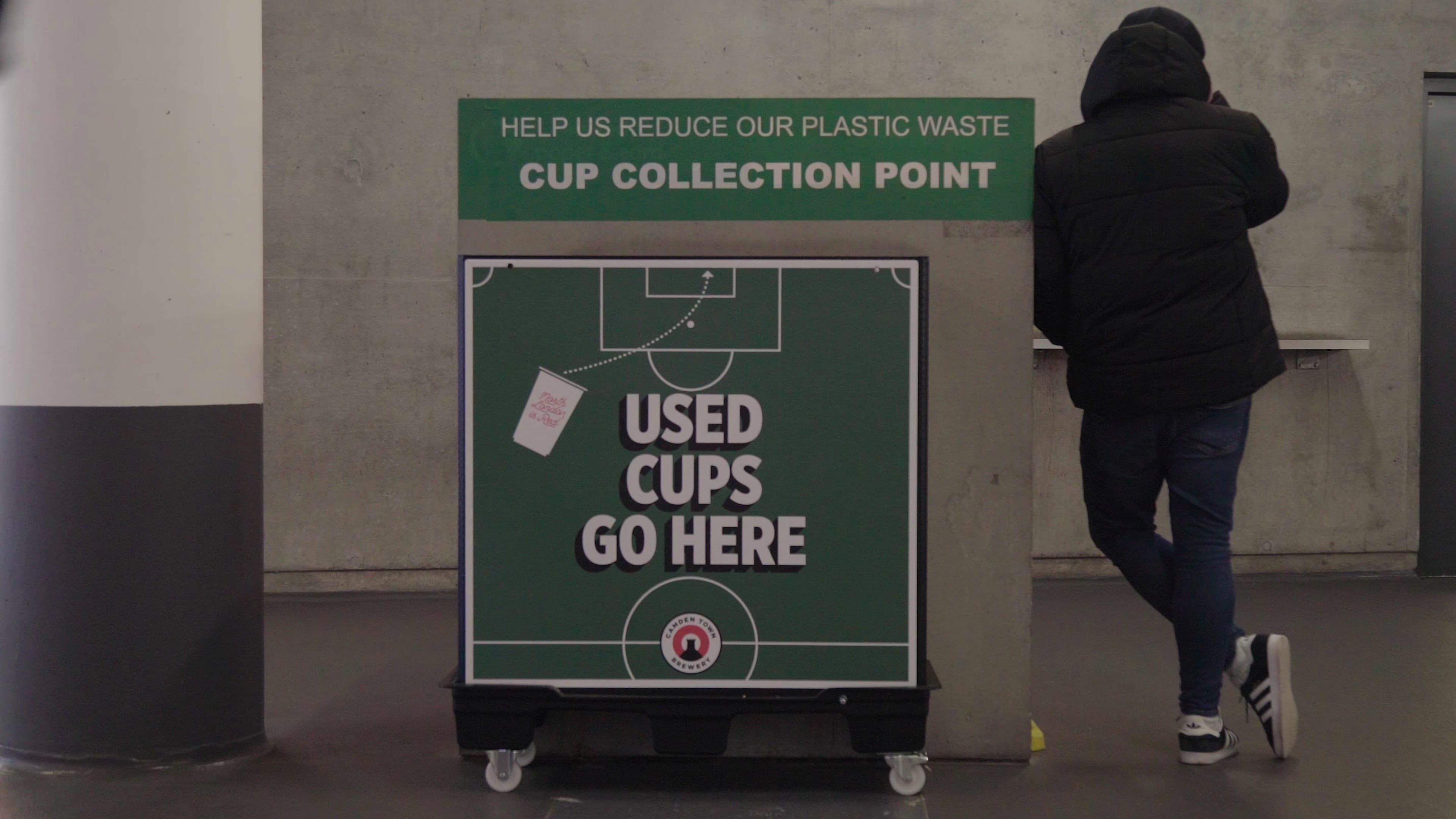
Manchester's guide says reusable systems require collection, washing and auditing, with storage space centrally and behind each bar. It recommends communication before the event, clear signage at bars and effective staff briefings. It also identifies visible, convenient return points as a way to reduce cup losses.1
Translate that into an event plan with named owners:
- Bar manager: opening allocation, exchanges and close count
- Cup-store lead: clean and used stock separation
- Collection team: route and collection frequency
- Wash provider: handover, turnaround and returned quantity
- Event communications: customer instructions and signs
- Production lead: reconciliation and post-event collection
The reusable system does not replace the wider waste plan. In England, the Simpler Recycling rules apply to temporary event venues, including festivals and outdoor shows. In-scope workplaces must separate dry recyclable materials, food waste and non-recyclable waste before collection, including waste produced by customers and visitors. Defra also recommends clear instructions and monitoring to reduce contamination.4 Organisers in Scotland, Wales and Northern Ireland should check the current requirements that apply in that nation.
Keep cup-return points visually distinct from waste and recycling bins. A cup intended for washing should not depend on a customer recognising it as different from disposable packaging.
For more detail on the stages after artwork approval, see how Cup Heroes handles the process.
When to place the order
There is no responsible universal answer in weeks. Timing depends on product availability, quantity, print method, artwork readiness, production capacity, destination and the date by which the event team needs stock onsite.
Use four decision gates instead.
1. Procurement gate
Before requesting the final quotation, document:
- event and delivery dates
- delivery address and access restrictions
- cup products and quantities by size
- washing and return model
- whether the stock is being bought or supplied under a service arrangement
- any split deliveries or collection requirements
Ask the supplier to confirm capacity and the latest safe approval date for that exact specification. Cup Heroes' lead-time guidance can help you prepare the dates and information needed for that conversation.
2. Artwork gate
Do not release artwork while sponsors, drink sizes or quantities are still changing. Obtain written approval for:
- final artwork
- product and capacity
- fill-line requirements
- print coverage and colours
- quantity for every design and size
- delivery date and address
A date mentioned during an early conversation is not a production commitment. Ask for the agreed date against the final specification.
3. Production and delivery gate
Record who will receive the delivery and how discrepancies will be handled. Leave time before public opening to:
- count the stock
- inspect representative printed cups
- separate quantities by size
- allocate opening stock to bars
- prepare reserve stock
- confirm the collection and washing route
Do not arrange delivery at the same time the bars are expected to start serving.
4. Event-readiness gate
Before gates open, run a short briefing with bar, stewarding, cleaning and waste teams. Everyone should know where clean cups come from, where used cups go, what customers are told, and who records stock movements.
If the event date is fixed but the specification is not, contact Cup Heroes with the known date, sizes, estimated quantities and artwork status. The useful answer is a written plan for the actual job, not a generic promise.
Sources
- Reusable Cups at Events: Why It Matters and How to Do ItManchester City CouncilAccessed 17 September 2026
- Weights and measures: the law: Specified quantitiesUK GovernmentAccessed 17 September 2026
- WM 1008: Intoxicating liquor measuring equipment, version 1, March 2026Office for Product Safety and StandardsAccessed 17 September 2026
- Simpler recycling: workplace recycling in EnglandDepartment for Environment, Food and Rural AffairsAccessed 17 September 2026